Ventilation & Odor Solutions for Open-Plan Small Kitchens

An open-plan small kitchen is a beautiful thing. It opens up sight lines, lets natural light travel further, and makes a compact home feel surprisingly generous. Yet the very feature that makes these layouts so appealing — the lack of walls — is also what allows the smell of last night’s garlic, fried fish, or browned onions to drift straight into your sofa cushions and stay there.
Effective small kitchen ventilation is the quiet hero of comfortable open-plan living. With the right combination of extraction power, smart airflow, and gentle daily habits, you can cook anything you like without your living space paying the price. This guide walks you through every practical layer of odor control, from choosing the right range hood to natural fixes you already have in your pantry.

If you prefer a quick visual walkthrough before diving in, the short video below demonstrates the core small kitchen ventilation techniques in action — from positioning your range hood correctly to the simple airflow habits that stop cooking odors before they spread.
With those ventilation fundamentals in mind, the sections that follow break each method down in detail so you can build a complete odor-control strategy tailored to your own open-plan layout. Before reaching for scented candles or a stronger air freshener, it helps to understand why open layouts behave so differently from closed kitchens. Once you see how cooking odors actually travel through a shared space, the solutions become far easier to prioritize — and you stop wasting money on products that only mask the problem instead of removing it.
Why Open-Plan Small Kitchens Trap Odors More Easily
In a traditional kitchen with four walls and a door, cooking smells are contained in a single, sealable room. You can shut the door, open a window, run an extractor, and the rest of your home stays largely unaffected. An open-plan small kitchen removes that boundary entirely. The moment oil hits a hot pan, microscopic grease and odor particles become airborne and immediately begin spreading through the connected living and dining zones.
Two factors make this worse in compact homes. First, the total air volume is small, so concentrated cooking fumes saturate the space quickly and have nowhere to dissipate. Second, soft furnishings — sofas, curtains, rugs, and cushions — sit close to the cooking zone and act like sponges, absorbing odor molecules and releasing them slowly for hours or even days afterward. This is precisely why a small open kitchen can smell faintly of last night’s dinner even after every dish is washed and put away.
The Hidden Cost of Lingering Cooking Smells
Beyond simple discomfort, poor kitchen ventilation in a small open space carries real wellness consequences. Cooking — particularly frying and high-heat searing — releases fine particulate matter and gases such as nitrogen dioxide that can irritate the lungs over time, especially in enclosed, low-volume rooms. For anyone sensitive to indoor air quality, this is more than an inconvenience.
- Grease particles settle on walls, cabinets, and electronics, leaving a sticky film that attracts dust.
- Persistent odors cling to upholstery and bedding, lowering the overall freshness of the home.
- Excess moisture from cooking raises humidity, encouraging condensation and mold in small spaces.
- Reduced indoor air quality can aggravate allergies, headaches, and respiratory sensitivity.
Viewing ventilation as part of your wellness routine — not just a cleanliness chore — completely reframes the priority. The goal is a home that feels genuinely fresh, breathable, and comfortable, which is exactly what a small space should deliver.
Choosing the Right Ventilation for a Small Open-Plan Kitchen
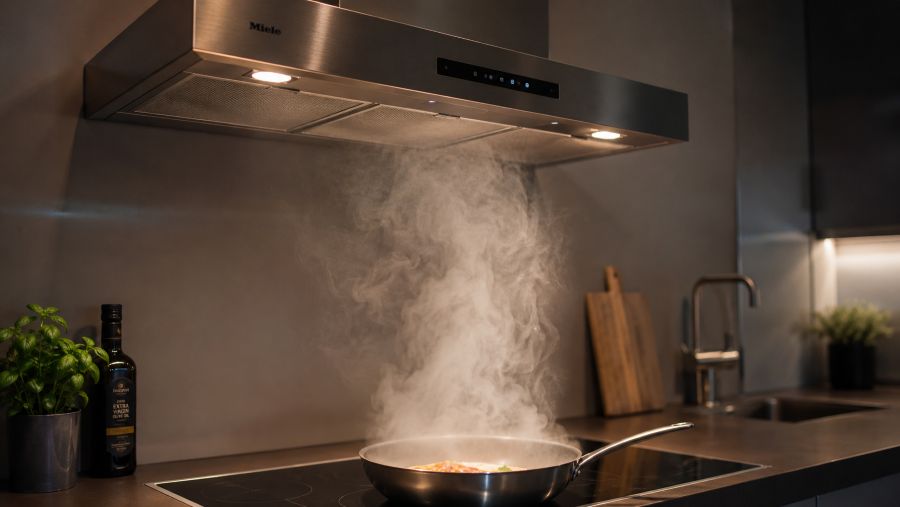
The single most impactful upgrade you can make is a properly sized, properly used range hood. It works by capturing odors, steam, and grease at the exact point they are created, before they have any chance to spread. However, not every hood suits every home, and small open-plan kitchens come with their own constraints around space, power, and the practicality of external ducting.

Smart Small Space Tip: Turn your range hood on a few minutes before you start cooking and leave it running for 10 to 15 minutes after you finish. This creates continuous airflow that captures odors as they form and clears the residual fumes that would otherwise settle into your open living area.
Ducted vs. Recirculating Hoods
Ducted (or vented) hoods are the gold standard. They pull air through the hood and expel it outside through ductwork, removing odors, heat, and moisture completely. If your kitchen sits against an external wall and ducting is feasible, this is the most powerful choice for an open-plan layout. Recirculating hoods, by contrast, draw air through grease filters and activated carbon, then return the cleaned air to the room. They are perfect for apartments and interior walls where external venting is impossible, though they rely entirely on the quality and freshness of their carbon filters.
Matching Power to Your Space
Airflow is measured in cubic feet per minute (CFM) or cubic meters per hour. As a practical baseline, aim for roughly 100 CFM for every linear foot of cooktop, then increase that figure for open-plan layouts where odors travel freely into adjacent zones. A hood that is too weak simply will not capture enough air to make a difference, while an excessively powerful one in a sealed small home can create negative pressure. The sweet spot is a hood that comfortably covers your cooktop width and offers a quiet, effective boost setting for heavy cooking.
Comparing Your Ventilation Options
To make the decision easier, the table below summarizes how the most common ventilation solutions perform specifically in a small open-plan kitchen, where space, noise, and odor reach all matter more than in a larger closed room.
| Solution | Best For | Odor Control | Considerations |
|---|---|---|---|
| Ducted range hood | Kitchens on an external wall | Excellent | Needs ductwork; highest installation effort |
| Recirculating hood | Apartments & interior walls | Good | Requires carbon filter changes every 3–6 months |
| Downdraft extractor | Island cooktops, sleek looks | Moderate | Less effective on tall pots; higher cost |
| Window + fan combo | Budget setups, mild cooking | Moderate | Weather-dependent; works best with cross-breeze |
| Air purifier (carbon) | Supplementing any hood | Supportive | Cleans ambient air but not at the source |
Natural and Low-Cost Odor Solutions
Mechanical ventilation does the heavy lifting, but a layered approach always wins. Natural odor solutions complement your range hood beautifully, costing little and avoiding the synthetic perfumes that can overwhelm a compact home. Crucially, these methods neutralize or absorb odors rather than simply covering them, which keeps the air genuinely clean instead of merely fragranced.
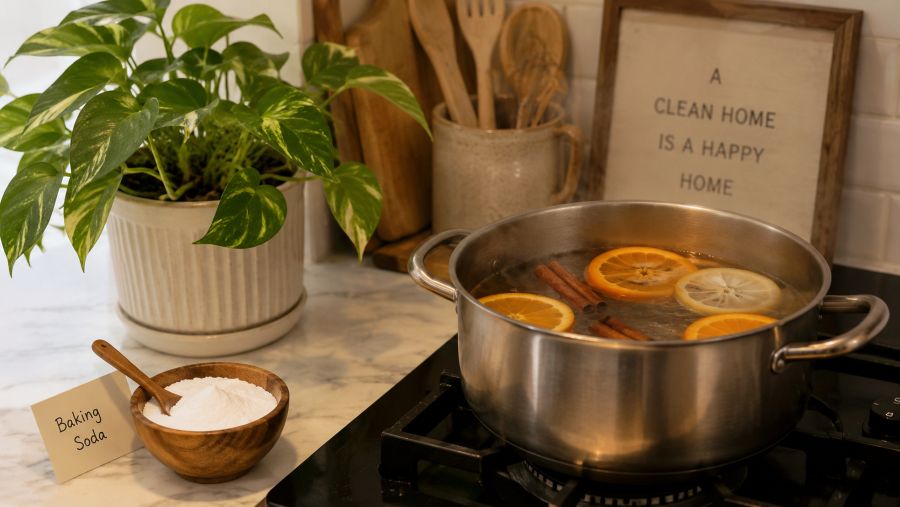
A gentle simmer pot is one of the most pleasant fixes available. Filling a small saucepan with water, citrus peels, a cinnamon stick, and a splash of vinegar, then letting it barely simmer, releases neutralizing steam that genuinely freshens the air. Open bowls of baking soda placed discreetly near the cooking zone quietly absorb stubborn smells, and replacing them monthly keeps them effective. White vinegar left in a small dish overnight is another time-tested trick for clearing strong lingering odors after fried or fishy meals.
Greenery adds a final, dual-purpose layer. Hardy plants such as peace lilies, spider plants, and pothos help filter the air while softening a compact kitchen visually — a perfect fit for the small space wellness mindset. Position them near the window or along open shelving where airflow can move past their leaves, and they become a living part of your ventilation strategy rather than mere decoration.
Ventilation Strategies for Renters and No-Duct Apartments
Not everyone can drill through an external wall or install permanent ductwork, and renters in particular need solutions that are powerful yet completely reversible. The good news is that some of the most effective small kitchen ventilation upgrades require no construction at all. A quality countertop or wall-mounted recirculating hood with a fresh activated carbon filter handles the bulk of odor and grease without venting outside, making it the single best fixed investment for an apartment.
Beyond the hood, a portable air purifier with a true carbon-and-HEPA filter is the most flexible tool you can own. Placed near the boundary between the kitchen and living zone, it intercepts drifting particles and odor molecules before they reach your soft furnishings. Because it is unplugged-and-moved in seconds, it follows you to your next home without leaving a single mark behind. Pairing it with a compact clip-on or window fan to actively push stale air outward turns even the most basic rental kitchen into a surprisingly breathable space.
Renters should also lean harder on the no-cost behavioral layer, since it costs nothing and breaks no lease. Cooking on lower heat when possible, favoring methods like steaming and simmering over heavy frying, and timing your most aromatic meals for when you can open windows all reduce the load on your equipment. These small adjustments mean your portable tools never have to work beyond their limits.
Daily Habits That Keep Your Open Kitchen Fresh
Even the best equipment underperforms without good routines. The most reliable way to control odor in an open-plan small kitchen is to stop smells before they accumulate, and that comes down to a handful of consistent daily habits that take seconds rather than minutes.
- Cover your pans: Lids trap steam and odor, dramatically reducing how much escapes into the room.
- Wipe surfaces immediately: Grease left on counters and the cooktop keeps releasing odor for hours.
- Empty the bin often: An open-plan layout means kitchen waste smells reach the whole living space, so a sealed, frequently emptied bin is essential.
- Clean filters on schedule: A clogged grease or carbon filter cuts your hood’s effectiveness in half.
- Ventilate after cooking: Crack a window and keep airflow moving for at least 10 minutes once the meal is done.
Together, these habits form a quiet maintenance rhythm. In a small space, consistency matters more than intensity — a few seconds of prevention each day prevents the slow, cumulative buildup that turns a fresh home into a stale one.
FAQ: Open-Plan Small Kitchen Ventilation
How do I stop cooking smells from spreading in an open-plan small kitchen?
The most effective method is to run a ducted or strong recirculating range hood while you cook, capturing odors at the source before they reach your living area. Combine this with cross-ventilation by opening a nearby window, keeping a lid on simmering pots, and ventilating for 10 to 15 minutes after you finish cooking.
Do recirculating range hoods work in small kitchens without ductwork?
Yes. Recirculating hoods filter grease and odor particles through activated carbon filters and return cleaned air to the room. They are ideal for apartments and small spaces where external ducting is impossible, although they are less powerful than ducted models and require regular filter replacement every three to six months.
What natural methods remove cooking odors in a small open kitchen?
Simmering water with citrus peels, cinnamon, or vinegar neutralizes lingering smells, while bowls of baking soda absorb persistent odors near the cooking zone. Air-purifying plants, frequent surface cleaning, and an air purifier with a carbon filter all help maintain fresh air without overpowering artificial fragrances.
What size range hood do I need for a small open-plan kitchen?
Your hood should be at least as wide as your cooktop, and its airflow rating should match your room. As a rule of thumb, aim for around 100 CFM for every linear foot of cooktop, adjusting upward for open-plan layouts where odors can drift into adjacent living areas.
Bringing Fresh Air Into Your Small Space
An open-plan small kitchen does not have to mean a home that smells like its last meal. By layering the right ventilation — a correctly sized range hood, intentional cross-ventilation, supportive natural odor solutions, and a few painless daily habits — you keep your air clean and your living space genuinely fresh. Each layer covers a weakness in the others, and together they let you cook freely without compromise.
Think of fresh, breathable air as a core pillar of small space wellness, every bit as important as good lighting or smart storage. When the space you live, cook, and relax in feels clean to breathe, the whole home feels lighter, calmer, and far more inviting — which is exactly what compact living should offer.
ADeL A.A
ADeL A.A is a home décor and space optimization writer who believes every square foot matters. He spends his time researching, testing, and comparing smart storage ideas, multi-functional furniture, and practical layout solutions — always searching for the best ways to make compact homes feel bigger, brighter, and better organized.
View all articles by ADeL A.A →