How to Reduce Noise in a Small Apartment (Renter-Friendly)

Few things drain the calm out of a small home faster than constant noise. When every square foot is shared between living, sleeping, cooking, and working, sound has nowhere to hide. Thin walls, hard floors, and close neighbors turn a cozy apartment into an echo chamber where footsteps, traffic, and late-night conversations all seem to land directly in your living room.
The good news is that you do not need a construction crew, a renovation budget, or your landlord’s permission to fix it. This guide walks through practical, damage-free ways to reduce noise in a small apartment using soft furnishings, smart placement, and a handful of affordable accessories. Every method here is fully renter-friendly, which means nothing gets drilled, glued, or left behind when you move out.

Before reaching for products, it helps to understand a simple truth about sound: hard, empty surfaces reflect noise, while soft, dense materials absorb it. A small apartment with bare walls, tile or laminate floors, and minimal furniture behaves almost like a drum. Sound waves bounce from surface to surface, building up until even ordinary conversation feels loud. Every soft item you add, from a rug to a cushion, quietly removes some of that echo. With that principle in mind, the strategies below move from the easiest free fixes to the more deliberate upgrades, so you can stack them in whatever order suits your space and budget.
If you prefer to see these renter-friendly noise reduction ideas in action before you start, the short walkthrough below brings the key techniques to life, showing how soft furnishings, smart placement, and simple door seals transform a noisy small apartment into a calmer space. Watch it first, then follow along with the detailed steps in the rest of this guide.
Where Apartment Noise Actually Comes From
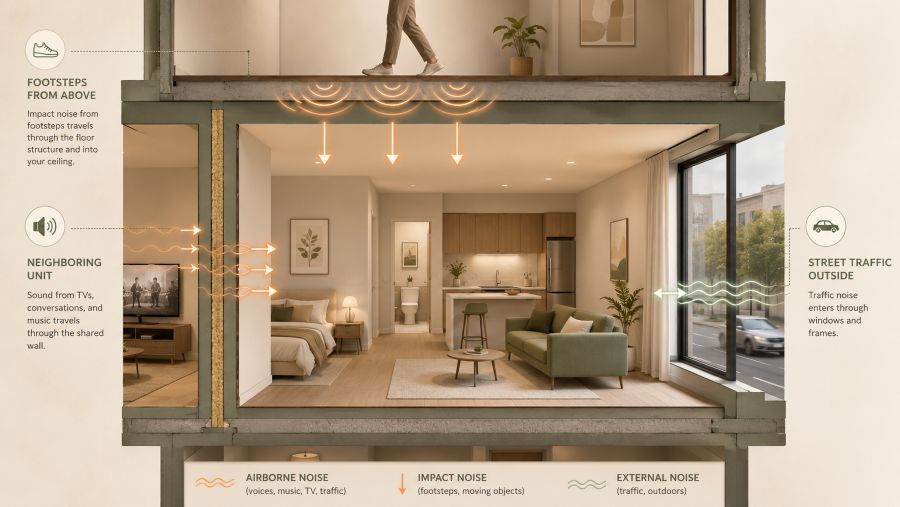
Reducing noise effectively starts with knowing which type of sound you are fighting, because the solution changes depending on the source. In a typical small apartment, the noise that disturbs you falls into a few distinct categories, and most renters are dealing with more than one at the same time. Treating them as a single problem usually leads to disappointment, while addressing each one with the right approach delivers noticeably better results.
The Two Main Types of Sound
- Airborne noise travels through the air and slips through gaps: voices, television, music, barking dogs, and street traffic. It enters through windows, doors, vents, and thin walls, and it responds well to absorption and sealing.
- Impact noise is created by physical contact with the building structure: footsteps overhead, furniture dragging, doors slamming, and plumbing. It travels through floors and ceilings, and it is the hardest type to control as a renter, though softening surfaces still helps.
- Echo and reverberation is noise you generate yourself bouncing around an empty, hard-surfaced room. This is the easiest category to fix and the one most improved by soft furnishings.
Spend a day simply paying attention to your apartment. Note when the worst noise happens, which direction it comes from, and whether it is a voice carrying through a wall or footsteps drumming overhead. This quick audit tells you exactly where to focus, so you spend your effort and money where it will actually be felt rather than guessing.
Soft Furnishings: Your Most Powerful Renter-Friendly Tool
If there is one principle that defines renter-friendly noise reduction, it is this: fill your space with soft, absorbent materials. Unlike permanent soundproofing, soft furnishings require no installation, leave no marks, and double as décor. In a small apartment, they are also a natural fit, because the same plush textures that quiet a room also make it feel warm and inviting rather than cramped and clinical.
Start from the ground up, because floors are often the single biggest source of echo in a rental. A large, thick area rug, ideally with a dense felt pad underneath, absorbs footstep noise, softens reflections, and stops sound from traveling down to neighbors below. The bigger and thicker the rug, the more effective it is, so resist the urge to choose a small accent piece when a room-filling rug will do far more work. Layering a second rug in a high-traffic zone adds even more dampening in spots where you walk most.
Move next to the windows, which are usually the weakest link against outside noise. Swapping thin blinds for heavy, floor-length curtains, especially layered or thermal-lined ones, creates a soft barrier that muffles traffic and street chatter. Hanging the curtain rod higher and wider than the window frame lets the fabric cover more wall area, increasing both the absorption and the sense of height in a small room. For the walls themselves, a large fabric tapestry, a quilted hanging, or even a padded headboard against a shared wall adds mass exactly where airborne noise tries to pass through.

Smart Small Space Tip: A bookshelf is a secret weapon against neighbor noise. Position a tall, fully stocked shelf flush against the shared wall that bothers you most. The irregular surface of book spines scatters sound waves while the combined mass of paper blocks airborne noise, all without a single drill hole. Pack it densely from top to bottom for the best results.
Sealing the Gaps Where Sound Sneaks In
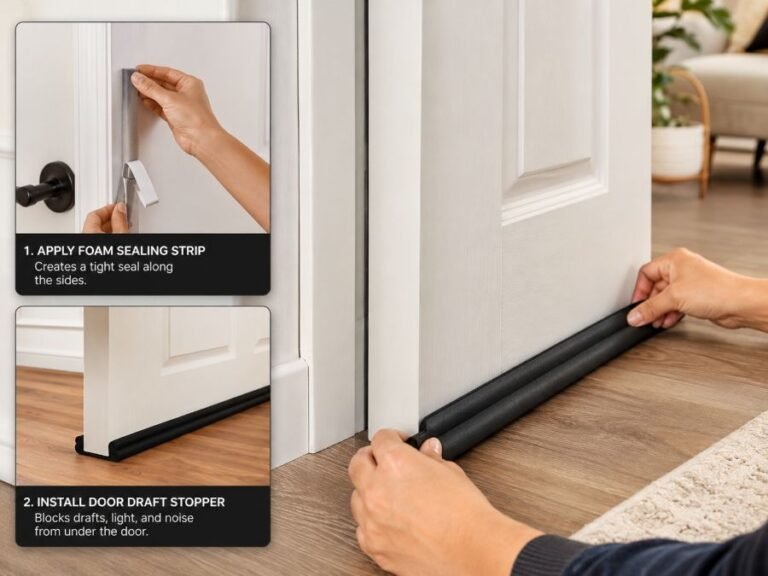
Soft furnishings handle absorption beautifully, but they cannot stop sound that pours through open gaps. In most small apartments, the largest unsealed gap is the bottom of the front door, where a clear inch of space lets hallway noise, cooking smells, and drafts flow straight in. A simple under-door draft stopper, the kind that slides on or sits as a weighted tube, dramatically cuts both noise and energy loss. It is one of the cheapest upgrades available and one of the most immediately noticeable.
Interior doors deserve attention too, particularly the bedroom door if you share walls with a noisy living area or a roommate. Self-adhesive foam weatherstripping tape, applied around the door frame, closes the thin perimeter gaps that voices slip through. Because the tape is removable, it peels away cleanly when your lease ends. For windows, the same weatherstripping seals rattling frames, while a removable rubber gasket or a rolled towel along the sill blocks low-frequency rumble from traffic. The table below compares the most common renter-friendly options so you can match each fix to its strength.
| Solution | Best For | Approx. Effort & Cost |
|---|---|---|
| Thick area rug + felt pad | Floor echo & footstep noise | Easy / Medium cost |
| Heavy lined curtains | Street & window noise | Easy / Medium cost |
| Full bookshelf on shared wall | Neighbor voices & airborne noise | Easy / Low cost (uses what you own) |
| Under-door draft stopper | Hallway & doorway noise | Very easy / Very low cost |
| Foam weatherstripping tape | Door & window frame gaps | Easy / Very low cost |
| Removable acoustic panels (strips) | Echo & recording / call clarity | Medium / Medium cost |
| White noise machine or fan | Masking unavoidable noise | Very easy / Low cost |
Tackling Floor and Ceiling Noise
Impact noise from above is the most common complaint among apartment renters, and it is also the most stubborn. Footsteps, dropped objects, and dragging furniture travel through the building structure itself, which means absorption inside your own unit can only do so much. Still, there are meaningful steps that take the edge off without any permanent changes. Thick rugs and pads on your own floor reduce the noise you create for neighbors below, which keeps the peace in both directions and often encourages reciprocity.
For ceiling noise coming from above, your influence is limited, but layering the room helps the space feel calmer even when you cannot eliminate the source. Adding soft surfaces throughout the room, a canopy or fabric draping over a bed, plush seating, and plenty of textiles, lowers the overall reverberation so incoming sound feels less sharp. When the disturbance is persistent and severe, a polite conversation with the upstairs neighbor or a note to your property manager is sometimes the most effective tool of all, since impact noise frequently comes down to a missing rug in their unit rather than anything you can fix in yours.
Smart Layout and Sound Masking
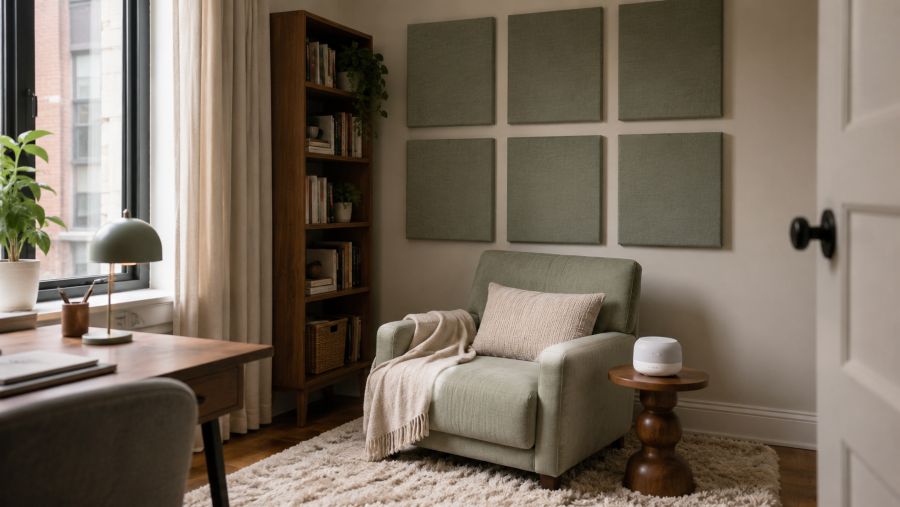
Beyond materials, where you place things matters enormously in a small space. Use your bulkiest, softest furniture as a buffer. A sofa, an upholstered bed, or a heavy wardrobe positioned against a shared wall puts mass between you and the noise source. Arrange your quietest activities, sleeping and focused work, on the side of the apartment farthest from the loudest external source, whether that is a busy street or a shared hallway. Even rotating a bed ninety degrees so the headboard sits against an interior wall rather than an exterior one can noticeably improve your night’s sleep.
When noise simply cannot be eliminated, the next best strategy is to mask it. The human brain is far more disturbed by sudden, irregular sounds than by a steady, neutral backdrop. A white noise machine, a quiet fan, or a soft playlist of ambient sound fills the silence between disturbances so that a slamming door or a passing car no longer jolts you. Many renters find that a small sound machine on the nightstand transforms restless nights more reliably than any physical barrier, simply because it changes how the brain perceives the remaining noise.
Finally, do not underestimate the cumulative effect of layering these methods. No single fix will silence an apartment, but a rug plus curtains plus a full bookshelf plus a sealed door plus a white noise machine adds up to a dramatically calmer home. Build your quiet space one affordable, removable layer at a time, and you will reach a level of peace that feels almost like a different apartment, all without touching the structure or risking your deposit.
Where to Spend First on a Tight Budget
If you can only act on one or two things this month, prioritize by impact rather than price. The most cost-effective starting point is almost always the floor and the front door, because they address the two largest pathways for noise at once. A generous area rug with a thick pad tackles both the echo inside your room and the footstep noise you send to neighbors, while an under-door draft stopper closes the single biggest air gap in most apartments. Together these two changes cost very little yet produce an immediately audible difference, which makes them the smartest first investment for any renter testing the waters.
From there, the next dollar is best spent on the wall or window that troubles you most, identified during your noise audit. Heavy curtains for a street-facing window, or a packed bookshelf against a shared wall, will outperform scattered small purchases every time. Resist the temptation to buy a little of everything at once. Instead, fully solve one source before moving to the next, and you will always feel the progress rather than wondering whether your money made any difference at all.
FAQ: Reducing Noise in a Small Apartment
Can you soundproof an apartment without damaging the walls?
Yes. Most renter-friendly noise reduction relies on absorption rather than construction. Thick rugs, heavy curtains, fabric wall hangings, bookshelves, and removable acoustic panels mounted with damage-free strips all soften sound significantly without drilling, gluing, or losing your security deposit.
What is the cheapest way to reduce noise in a small apartment?
Start with what you already own. Rearranging soft items such as throw blankets, cushions, and a full bookshelf against a shared wall costs nothing. After that, an under-door draft stopper and a single large area rug deliver the biggest noise reduction for the lowest price, usually under fifty dollars combined.
Do acoustic foam panels actually work in apartments?
Acoustic foam reduces echo and improves sound quality inside a room, but it does very little to block noise coming from neighbors. For voices, footsteps, and traffic passing through walls, dense and heavy materials like rugs, curtains, and bookcases are far more effective than thin foam panels.
How do I block noise coming from a noisy neighbor?
Identify the shared wall and add mass to it. Position a tall bookshelf packed with books against that wall, hang a heavy fabric tapestry or quilted moving blanket, and place a soft rug on the floor nearby. Combined, these layers absorb and dampen the sound far more than any single fix.
A Quieter Small Space Is Within Reach
Living in a small apartment does not mean surrendering to noise. By understanding where sound comes from and responding with soft, dense, damage-free layers, any renter can carve out a calmer, more restful home. Begin with the free changes, rearranging what you own and adding mass to the walls that bother you, then build outward with rugs, curtains, door seals, and a touch of sound masking. Each layer is reversible, each one earns its place as décor, and together they turn a noisy box into the peaceful retreat a small space is meant to be.
ADeL A.A
ADeL A.A is a home décor and space optimization writer who believes every square foot matters. He spends his time researching, testing, and comparing smart storage ideas, multi-functional furniture, and practical layout solutions — always searching for the best ways to make compact homes feel bigger, brighter, and better organized.
View all articles by ADeL A.A →