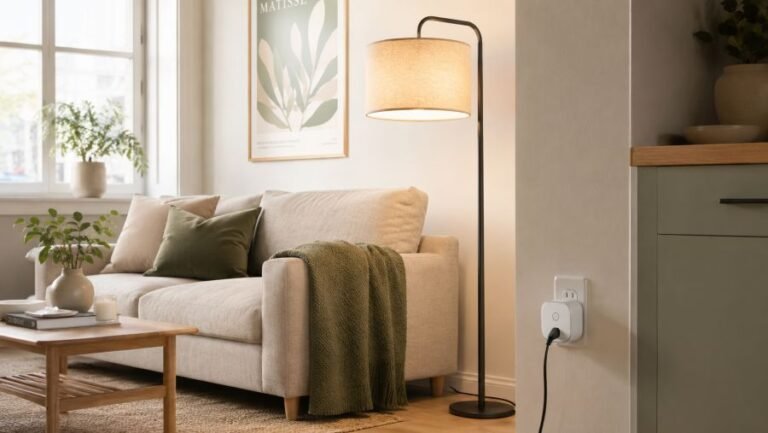
How to Hide Cables and Chargers in a Small Apartment

In a small apartment, there is nowhere for clutter to quietly disappear — and nothing announces “mess” quite like a knot of black cables crawling across the floor, a charging brick dangling off the nightstand, or a power strip glowing under the sofa. When square footage is tight, every visible cord competes for the same visual space as your furniture, your art, and the little bit of breathing room you fought so hard to protect.
The good news is that taming cables doesn’t require a renovation, a heavy toolbox, or a single hole in the wall. With a handful of inexpensive tools and a few thoughtful habits, you can route, conceal, and corral nearly every wire in your home. This guide walks through practical, renter-friendly ways to hide cables and chargers in a small apartment — room by room — so your space finally looks as calm as you want it to feel.
Smart Small Space is reader-supported. As an Amazon Associate, we earn from qualifying purchases made through links in this article — at no extra cost to you. Most of the tools below cost under $10.
Cable management is one of those small-space upgrades that pays off far beyond its effort. Hiding your cords won’t add a single square foot to your floor plan, yet it can make a studio or one-bedroom feel noticeably more spacious, more intentional, and easier to clean. Loose wires collect dust, trip up vacuum cords, and create a constant low-level visual noise your eye keeps snagging on. Remove them from view and the space immediately reads as more put-together. Below, we’ll start by understanding the problem, then move through the exact tools and techniques that make cords vanish.
Before we get into the step-by-step methods, here is a quick visual walkthrough that shows several of these cable-hiding ideas in action. In just over a minute, the video below demonstrates how to hide cables and chargers in a small apartment using the same renter-friendly tools and routing tricks we cover throughout this guide.
With that visual overview in mind, let’s break down each technique in detail so you can apply it to your own space, one zone at a time.
Why Cable Clutter Feels Worse in a Small Apartment
In a large home, a stray charging cable on the kitchen counter barely registers — there’s so much else to look at. In a small apartment, the same cable becomes a focal point. Compact rooms have shorter sight lines, fewer surfaces, and tighter zones, so anything that doesn’t belong stands out instantly. A single tangle near your desk can dominate an entire wall when that wall is only a few steps wide.
There’s also a practical layer. Small apartments tend to concentrate technology into one or two areas: a media wall, a desk that doubles as a dining table, a nightstand that holds three devices at once. That concentration means cords pile up in the very spots you use most, where they’re hardest to ignore and most likely to get yanked, kinked, or stepped on. Hiding cables in a small apartment is therefore not just about looks — it’s about protecting your gear and reclaiming the few high-traffic surfaces you have.
Start With a Cable Audit Before You Hide Anything
It’s tempting to grab a handful of clips and start sticking things to the wall, but the most effective cable management always begins with a quick audit. Before you conceal a single wire, you want to know what you actually have, what each cord does, and which ones you can eliminate entirely. This five-minute exercise prevents you from hiding a tangle that didn’t need to exist in the first place.
What to Check During Your Audit
- Unplug and identify every cable. Label each one with a small piece of tape so you never have to trace a wire blindly again.
- Remove the orphans. Chargers for devices you no longer own, that mystery USB cable, the second HDMI you never use — pull them out completely.
- Measure your lengths. Cables that are far too long create the bulk of visible tangle. Note which ones you can swap for shorter versions.
- Group by zone. Sort everything into the areas where it lives — TV wall, desk, bedside, kitchen — so you can solve each zone as its own small project.
Once you’ve trimmed the excess, the remaining cables become genuinely manageable. Most small apartments turn out to have far fewer “necessary” cords than they appear to — the visual chaos comes from length and disorganization, not quantity. With a clear inventory in hand, you can choose the right hiding method for each zone instead of fighting the same mess over and over.
Hide Cables Behind Furniture and Along the Wall
The fastest wins come from using what you already own. Your furniture is the best cable-hiding tool in the apartment, and you’re not adding a thing or spending a cent. The principle is simple: route cords behind, under, and along the edges of pieces you already have, so they follow lines your eye naturally ignores.
Behind the TV and Media Console
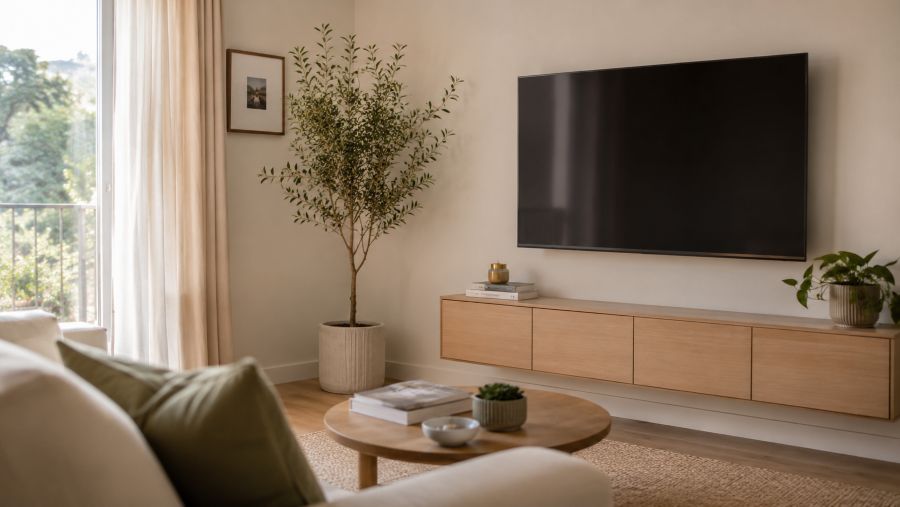
The media wall is usually the worst offender in a small living room, with power, HDMI, console, and streaming-device cables all converging in one spot. If your TV sits on a console, the easiest fix is to bundle all the cords with a fabric cable sleeve or a few velcro ties, then run that single neat bundle straight down to the back of the console where it’s invisible from the seating area. Mount a small power strip to the inside back panel of the console with adhesive tape so it never touches the floor.
For a wall-mounted TV, renters can use an on-wall cable raceway — a slim plastic channel with adhesive backing that you can paint to match your wall color so it nearly disappears. It holds the cords in a clean vertical line down to the console below. If you own the apartment, an in-wall cable pass-through kit lets you route cables behind the drywall for a completely floating look.
Under and Behind the Desk
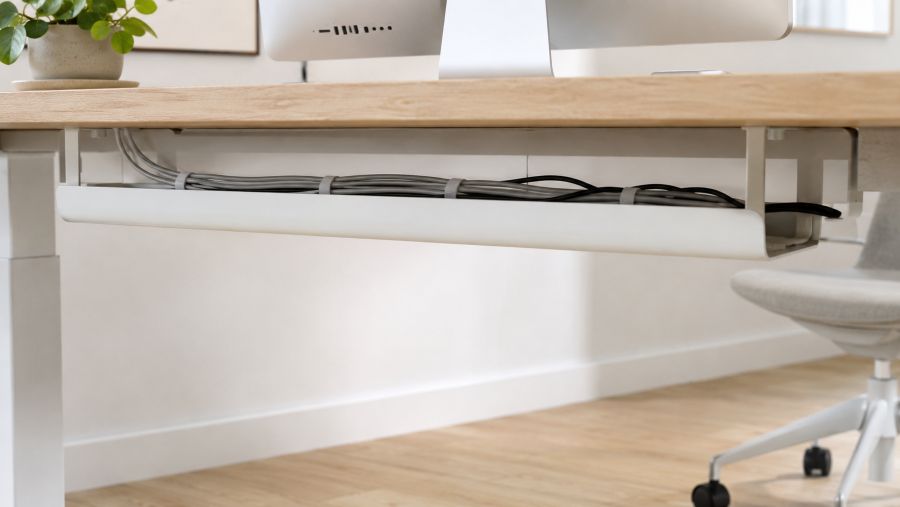
A desk in a small apartment often serves double duty, which makes a clean surface even more valuable. Stick an under-desk cable tray or a slim wire basket beneath the tabletop to hold your power strip and all the slack. Use adhesive cable clips along the back edge of the desk legs to guide cords straight down, and keep your charging cables threaded through a single desk cable grommet at the desk’s edge so they’re always within reach but never sprawling across the top.
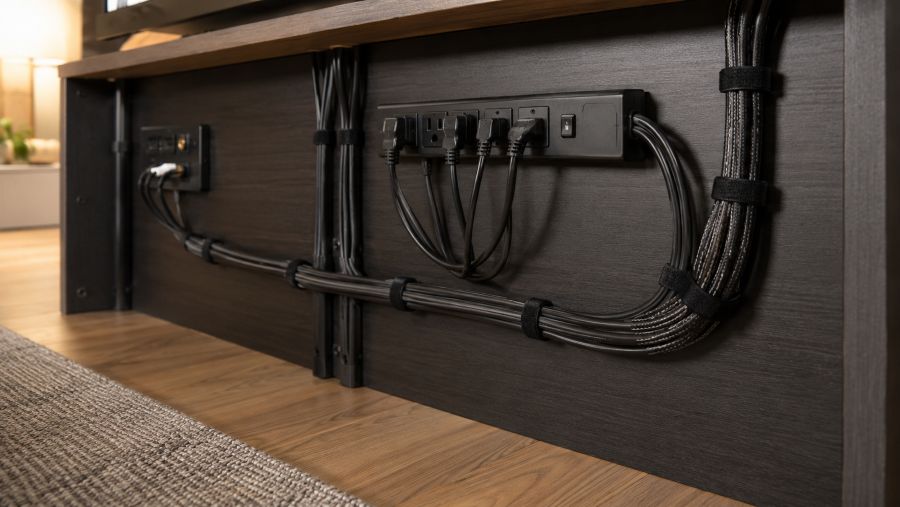
Smart Small Space Tip: Always route cables before you push furniture against the wall. Pull the piece out a few inches, set up your sleeves, clips, and power strip with full access, then slide it back. Trying to manage cords in a four-inch gap behind a heavy console is the fastest way to give up halfway.
Cable Management Tools That Actually Work
You don’t need an expensive system to hide cables in a small apartment — just the right small tools for each job. The table below breaks down the most useful options, what they’re best at, and roughly what you should expect to spend so you can build a setup that matches your space and budget.
| Tool | Best For | Renter-Friendly? | Typical Cost |
|---|---|---|---|
| Adhesive cable clips | Guiding single cords along desk edges and baseboards | Yes — removable adhesive | $5–$10 |
| Fabric cable sleeves | Bundling multiple cords into one clean tube | Yes | $8–$15 |
| On-wall raceway / cord cover | Hiding TV cables on the wall surface | Yes — paintable, peelable | $12–$25 |
| Under-desk cable tray | Holding power strips and excess slack off the floor | Yes — clamp or adhesive | $15–$30 |
| Cable box / power-strip cover | Concealing the power strip itself on the floor | Yes | $10–$20 |
| Velcro ties | Shortening and grouping long cables neatly | Yes — reusable | $5–$8 |
Notice that almost every option is both inexpensive and removable — exactly what a renter needs. You can build a complete cable-management kit for a small apartment for well under fifty dollars, and reuse most of it in your next place. Start with clips, sleeves, and velcro ties, then add trays and covers only where a zone really needs them.
Smart Ways to Hide Chargers and Charging Stations
Chargers are the cords that multiply fastest. A phone, a tablet, wireless earbuds, a smartwatch, maybe a laptop — each arrives with its own brick and cable, and in a small apartment they tend to colonize whichever surface is nearest the outlet. The single most effective move is to stop letting chargers spread and instead build one dedicated charging station that holds them all.
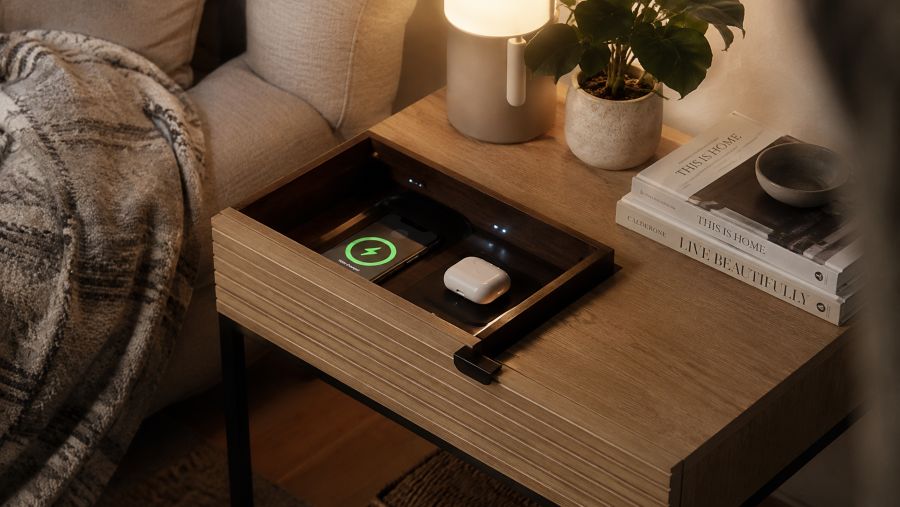
Pick a drawer, a decorative box, or a small lidded basket near an outlet. Place a compact power strip with surge protection inside, plug all your charging bricks into it permanently, and feed just the device-end of each cable out through a small notch or grommet. Now your chargers never leave the container — you simply drop a device in to charge and lift it out when it’s done. The cords stay completely hidden, the surface stays clear, and you’ll never hunt for a charger again.
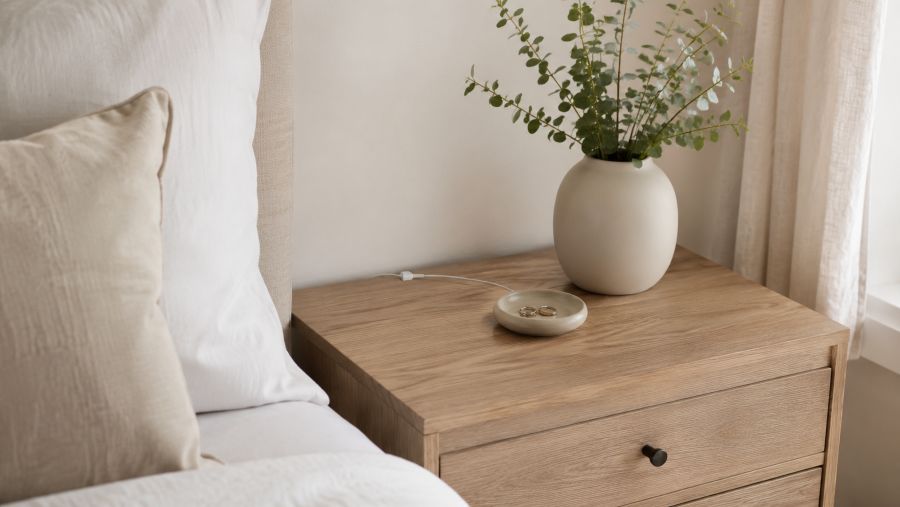
For bedside charging, a single adhesive clip on the back edge of the nightstand keeps one cable poised and ready while the brick stays plugged in behind the furniture, out of sight. If you have multiple devices to charge overnight, a slim multi-device charging dock or a multi-port USB wall charger consolidates several bricks into one, dramatically cutting the cord count on your most-seen surface.
Renter-Friendly Cable Hiding With No Drilling
If you rent, your cable solutions have to disappear as cleanly as they appear — no holes, no residue, no lost deposit. Fortunately, nearly every technique above works without a single screw. The key is choosing adhesive-based products rated for removable mounting and pairing them with smart routing that uses furniture instead of walls wherever possible.
- Use removable adhesive mounts. Command-style strips and adhesive cable clips hold cords securely yet peel off cleanly when you move, leaving the wall untouched.
- Route along baseboards, not across floors. A cord cover that follows the bottom of the wall is far less visible than a cable crossing open floor — and far safer to walk past.
- Hide power strips inside cable boxes. A simple lidded cable box turns an ugly strip into an anonymous object that blends with your décor.
- Lean on furniture placement. Position the sofa, bed, or console to naturally screen the outlet and the cords feeding into it.
- Choose shorter cables. Replacing a six-foot cord with a one- or two-foot version eliminates slack at the source, which is the cleanest fix of all.
Room-by-Room Cable Hiding Ideas
Every zone of a small apartment has its own cable personality, so it helps to tackle them one at a time. Here’s how the same principles adapt to the spaces you use most.
In the living room, the media wall is your priority — bundle and route TV cords down to the console, mount the power strip off the floor, and use a paintable raceway for any wall-mounted screen. In the bedroom, focus on the nightstand: a single clipped charging cable and a hidden brick keep your most personal space serene. In the home office or work corner, an under-desk tray and edge clips do almost all the heavy lifting, since this is where slack accumulates fastest. In the kitchen, where renters often charge phones and run small appliances, keep a single short charging cord clipped beside one outlet and unplug appliance cords when not in use rather than leaving them coiled on the counter.
Common Cable-Hiding Mistakes to Avoid
A few well-meaning habits actually make cable clutter worse — or, in some cases, unsafe. The most common mistake is running cords underneath a rug to hide them. It looks clean, but trapped cables can overheat, fray, and become a genuine fire risk, especially with anything carrying significant power. Hide cords beside or behind objects, never under foot traffic and insulation.
Another frequent error is over-bundling. Wrapping every cable into one fat, tightly coiled rope might look neat, but it concentrates heat, strains connectors, and makes any future change a nightmare. Use loose reusable velcro ties rather than tight, permanent wraps. Avoid daisy-chaining multiple power strips into one outlet, which overloads the circuit. And don’t forget to dust your hidden cables periodically — out of sight too often becomes out of mind, and a forgotten dusty tangle behind a console is exactly the kind of thing good cable management is meant to prevent.
FAQ: Hiding Cables and Chargers in Small Spaces
How do I hide cables in a small apartment without drilling?
Use adhesive cable clips, self-stick raceways, and behind-furniture routing. These renter-friendly tools attach with removable adhesive, keep cords out of sight along baseboards and furniture edges, and peel away cleanly when you move out without damaging walls.
What is the best way to hide phone and device chargers?
Create a single charging station inside a drawer, decorative box, or small basket. Run one power strip into the container, feed just the device-end of each cable out through a small notch, and keep all chargers permanently plugged in inside so cables never spread across your surfaces.
How can I hide the cables behind a wall-mounted TV?
Use an on-wall cable raceway painted to match the wall, or an in-wall cable pass-through kit if you own the apartment. Renters should bundle the cords with a sleeve and route them down to a console below, keeping the wire path tight against the wall edge.
Are cable clutter and dust a fire risk in small apartments?
Tangled, dusty cables and overloaded power strips can pose a real hazard. Keep cords uncoiled where possible, avoid running them under rugs where heat builds up, dust connections regularly, and never chain multiple power strips together to stay safe.
A Cleaner, Calmer Small Space Starts With the Cords
Hiding cables and chargers is one of the highest-impact, lowest-cost changes you can make in a small apartment. You don’t gain physical space, but you gain something just as valuable: visual quiet. When the cords disappear, your eye finally rests on the things you chose to display rather than the wires you never meant to. Start with a quick audit, lean on the furniture you already own, add a few removable tools where each zone needs them, and consolidate your chargers into a single hidden station. Tackle one zone this weekend — the media wall or the nightstand is a great place to begin — and you’ll feel the difference the moment you step back and see clean, open surfaces where the tangle used to be.
ADeL A.A
ADeL A.A is a home décor and space optimization writer who believes every square foot matters. He spends his time researching, testing, and comparing smart storage ideas, multi-functional furniture, and practical layout solutions — always searching for the best ways to make compact homes feel bigger, brighter, and better organized.
View all articles by ADeL A.A →