Best Robot Vacuums for Small Apartments: What Actually Matters

Shopping for a robot vacuum in a small apartment is one of the most confusing experiences in smart-home tech, and the reason is simple: nearly every spec brands push at you was written for big houses. Suction numbers climb into the tens of thousands, docks balloon into appliance-sized towers, and marketing implies that more power equals a cleaner floor. In a 500-square-foot studio, almost none of that is the spec that decides whether you are happy with your purchase.
This guide flips the script. Instead of ranking machines by raw suction, we focus on what actually matters in a compact home — the robot’s height, how it navigates, the footprint of its dock, and how loud it is when you are five feet away. Get those four right and even an affordable model will keep your apartment genuinely clean.
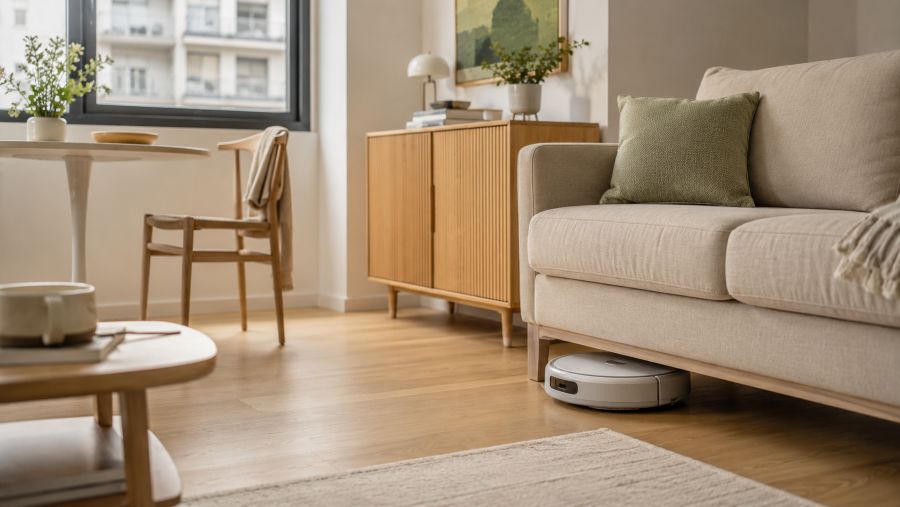
Here is the truth the big vacuum brands rarely lead with: robot vacuums were practically designed for apartments, even though they are marketed to everyone. A robot struggles in a sprawling multi-story home, where it gets lost, runs low on battery, and skips entire rooms. A small apartment, by contrast, is its natural habitat. A predictable layout of a few hundred square feet, mostly open floor, and a handful of rooms means one charge covers the whole place — and there is no awkward storage problem, because most models are flat enough to slide under a bed or couch when they are not docked.
If you’d rather see the key buying factors explained quickly before reading on, the short video below walks through what to look for in a robot vacuum for a small apartment — focusing on the same height, navigation, and noise priorities we’ll break down in detail.
With those fundamentals in mind, let’s look at why a compact home is the place a robot vacuum truly shines.
Why Small Apartments Are the Ideal Home for a Robot Vacuum
Counterintuitively, the less space you have, the better a robot vacuum performs. A smaller floor means each run finishes faster, the robot rarely runs out of charge mid-cycle, and your floors stay consistently clean rather than swinging between spotless and dusty. The value isn’t in deep, occasional cleaning — it’s in frequency. A short run every day removes dust and hair before it ever has a chance to accumulate, which is exactly the kind of low-effort maintenance compact living rewards.
This matters more in a small space than people expect. When furniture sits close together and open floor is limited, dust and debris collect aggressively around furniture edges, under the bed, and in corners that are awkward to reach by hand. A traditional upright vacuum is bulky to store and tedious to drag out for a five-minute job, so the cleaning simply gets postponed. A robot removes that friction entirely.
The Set-and-Forget Advantage
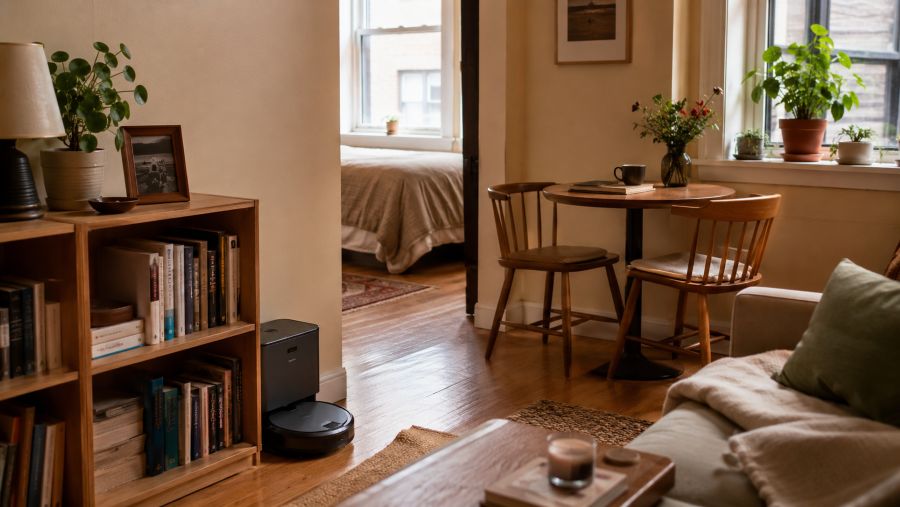
The real magic of a robot vacuum in a compact home is that it turns floor care into something you stop thinking about. Once you set a schedule, the routine runs itself. For renters, pet owners, and anyone who works from home, this consistency is the entire point.
- Daily maintenance, zero effort: A scheduled 15 to 20 minute run keeps dust and pet hair from building up, instead of saving it all for a dreaded weekend deep clean.
- No storage headache: A slim body tucks under furniture, so you don’t sacrifice a closet or corner to store a bulky upright.
- Cleaner air, fewer allergens: Frequent passes capture fine dust before it settles into fabric and corners, which compounds quickly in a closed, smaller space.
- Full coverage on one charge: A 400 to 800 square-foot home is comfortably handled in a single cycle, with no mid-run docking gaps.
What Actually Matters (Beyond the Suction Numbers)
When you are working with limited square footage, a handful of specs matter far more than the suction figure on the box. These are the ones worth obsessing over before you buy.
1. Height and Profile — The Spec Nobody Checks
This is the single most overlooked spec, and getting it wrong is the most common buyer mistake in apartments. Much of your furniture — the sofa, the bed frame, low cabinets — likely sits only 3 to 4 inches off the floor. A robot around 2.85 inches tall will glide underneath and clean the dust you can’t even see. A taller model near 3.7 inches will be physically blocked, leaving a meaningful share of your floor untouched, run after run.
The fix is almost embarrassingly simple: before you shop, grab a tape measure and check the clearance under your lowest furniture. Then buy a robot that fits beneath it. In a small apartment, that one measurement does more for cleanliness than any suction upgrade.
eufy RoboVac 11S MAX
At just 2.85 inches tall, this robot slips under low sofas and bed frames where bulkier models get stuck, runs at a quiet ~55 dB, and uses BoostIQ to ramp up suction automatically on rugs. There’s no app or mapping to fuss with — making it an ideal, affordable choice for a compact studio where height matters most.
Check Price on Amazon →2. Navigation — LiDAR vs. Random Bounce
Robot vacuums broadly navigate in one of two ways. Premium models use LiDAR or camera-based mapping to build a layout of your home and clean in systematic, overlapping rows. Budget models tend to bounce around semi-randomly, bumping off walls until they have statistically covered the floor. Systematic navigation can be 30 to 40 percent more thorough per run and unlocks features like room-by-room scheduling and no-go zones.
Here’s the nuance for small spaces, though: that advantage shrinks as the floor shrinks. In a studio under 500 square feet, or for anyone running the robot daily, even random navigation covers the space effectively — you’re simply not giving it enough room to get meaningfully lost. Mapping and app control are genuinely useful in a multi-room one-bedroom; in a single open studio, they rarely change the day-to-day result enough to justify the premium.
Roborock Q5 Robot Vacuum
If your apartment has separate rooms, precise LiDAR mapping lets this robot clean in tidy, systematic rows with room-by-room scheduling and no-go zones. A long runtime comfortably covers a one-bedroom on a single charge, making it the sensible upgrade when you actually have a layout worth mapping.
Check Price on Amazon →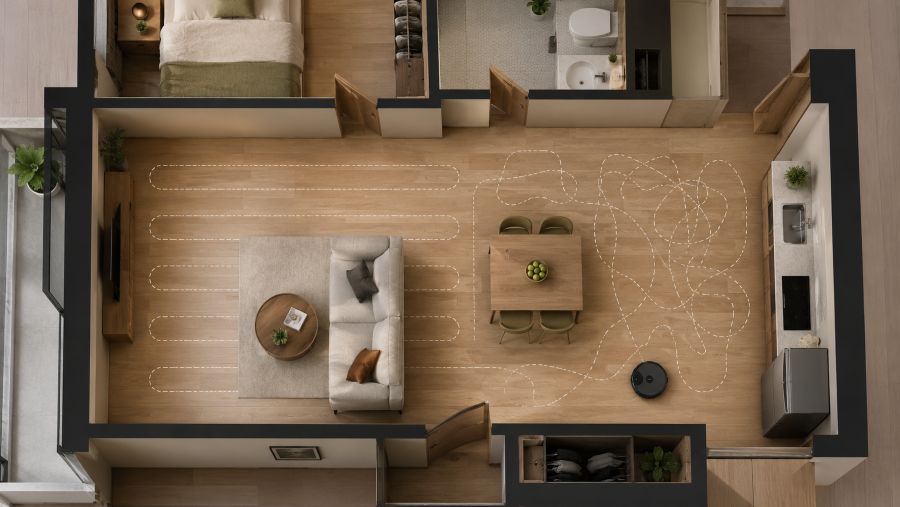
3. The Dock Footprint Trap
Everyone measures the robot’s height. Almost nobody measures the dock — and in a small apartment, that’s the real space cost. A basic charging dock is tiny. But a self-emptying or all-in-one station is a permanent fixture on your floor, and some auto-empty bases are roughly 300 by 400 millimeters, nearly the footprint of a carry-on suitcase. In a studio, that station lives in your living area indefinitely.
Self-emptying docks are a fantastic convenience — they let the robot run for weeks without you touching the bin — but they are a genuine trade-off in a tight footprint. Be honest about whether you have a discreet corner to give up. If you don’t, a slim charging-only dock with a manually emptied bin may be the smarter pick for your layout.
Smart Small Space Tip: Before you commit to a self-emptying model, tape out the dock’s exact dimensions on your floor with painter’s tape and live with it for a day. Walking around that footprint for 24 hours tells you more about whether it fits your apartment than any product photo ever will.
4. Noise Level — Because You’re Right There
In a big house you can banish the robot to a far wing while it works. In a small apartment, you are in the same room — possibly on a video call. Most modern robots run between roughly 51 and 65 decibels during a cleaning cycle, which lands below typical indoor noise guidelines and is comparable to a quiet conversation. That’s quiet enough to run while you’re home and even while you work.
The catch is the auto-empty dock again: when it empties the bin it briefly spikes to 75 decibels or more for about five seconds. It’s short, but it’s loud. The simple workaround is to schedule cleaning — and therefore the emptying cycle — for a window when you’re out of the apartment.
5. Mopping — What It Really Does (and Doesn’t)
Mopping is the feature most likely to be oversold. On budget two-in-one models, “mopping” usually means a passive water-soaked pad dragged behind the robot. It handles light surface residue and freshens hard floors, but it does not scrub, and it won’t replace a real mop on dried-on messes. Premium machines do far more — pressurized spinning pads, hot-water washing, even mop lifting over carpet — but you pay handsomely for it.
For a small apartment with tile in the kitchen and bathroom plus hardwood elsewhere, a simple two-in-one is genuinely useful as a daily maintenance tool: vacuum and a light damp pass in one run. Just calibrate your expectations. If your space is mostly carpet or low-pile rugs, prioritize vacuuming and treat mopping as a minor bonus rather than the main event — robots remain weak on thick, deep-pile carpet regardless of price.
Matching a Robot Vacuum to Your Space
Rather than crown one universal winner, it’s more useful to match a category of robot to the kind of small space and lifestyle you have. The table below pairs common apartment scenarios with the type of model — and a representative 2026 example — that tends to fit best.
| Your Situation | What to Prioritize | Representative 2026 Model |
|---|---|---|
| Tiny studio, tight budget, very low furniture | Slim 2.85″ profile, low noise, simple controls | eufy RoboVac 11S MAX (~55 dB, no app needed) |
| One-bedroom with separate rooms | LiDAR mapping, room-by-room scheduling | Roborock Q5 (room segmentation, long runtime) |
| Pet owner, daily shedding | Larger dustbin, anti-tangle/self-cleaning brush | Shark IQ AV970 (~570 ml bin, self-cleaning brushroll) |
| Hands-off, weeks between maintenance | Self-empty dock (if you have space for it) | eufy Auto-Empty C10 (~51 dB, multi-week bag) |
| Mixed tile + hardwood, want light mopping | Two-in-one vacuum/mop with carpet detection | Dreame budget LiDAR + mop tier |
Treat these as starting points rather than strict prescriptions. The thread running through all of them is the same: define your single biggest constraint — furniture clearance, room count, pet hair, dock space, or floor type — and let that decision drive the purchase. Optimizing for one real constraint beats chasing a spec sheet full of numbers that won’t matter in your square footage.
Common Mistakes Small-Space Buyers Make
Most disappointment with a robot vacuum in an apartment traces back to a few predictable missteps. Avoid these and you’ll likely love your purchase.
- Buying for suction, not height: A powerful robot that can’t fit under your sofa leaves a third of the floor permanently dirty. Measure clearance first, every time.
- Forgetting about the dock: A self-emptying base sounds great until it becomes a suitcase-sized object you trip over in a studio. Account for its footprint, not just the robot’s.
- Overpaying for mapping in a studio: In a small open space, premium navigation often doesn’t change the result enough to justify the price jump.
- Expecting carpet miracles: Robots are excellent on hard floors and short carpet, weak on thick pile. Know your floor type before buying.
- Leaving the floor cluttered: Loose cables, charger cords and small toys are a robot’s worst enemy. A tidy floor is part of the system, especially with budget models that lack obstacle avoidance.
FAQ: Robot Vacuums for Small Apartments
Are robot vacuums actually worth it in a small apartment?
Yes. Small apartments are arguably the ideal environment for a robot vacuum. A space of 400 to 800 square feet is cleaned in full on a single charge, the robot stores easily under furniture, and a short daily run keeps dust and pet hair from ever building up. For most studios and one-bedrooms, even a model under 150 dollars handles daily maintenance well.
What height robot vacuum do I need to clean under furniture?
Measure the clearance under your lowest furniture first. Many sofas, bed frames and cabinets sit just 3 to 4 inches off the floor. A robot around 2.85 inches tall will slide underneath, while a taller 3.7-inch model can be blocked from a large share of your floor. In a small apartment, height is often more important than suction power.
Do I need LiDAR navigation in a studio apartment?
Not necessarily. LiDAR maps your home and cleans in systematic rows, covering 30 to 40 percent more area per run than random-bounce navigation. That advantage shrinks in a very small footprint. If your apartment is under 500 square feet or you run the robot daily, a simpler gyroscope or random-navigation model will still cover the space effectively and cost noticeably less.
Are robot vacuums quiet enough to run while I’m home?
Most modern models run between roughly 51 and 65 decibels during cleaning, which sits below common indoor noise guidelines and is comparable to a quiet conversation or microwave. The main exception is the auto-empty dock, which spikes to 75 decibels or more for about five seconds while it empties the bin. Scheduling that emptying cycle for when you are out solves the issue.
The Bottom Line for Small Spaces
The best robot vacuum for a small apartment is rarely the most powerful one on the shelf — it’s the one that quietly fits your life. That means a body slim enough to clean under your lowest furniture, a dock you can actually find room for, a noise level you can tolerate while you’re home, and navigation matched to your room count rather than a brochure’s ambitions. Nail those, and the suction figure becomes an afterthought.
Start with your single biggest constraint and build the decision around it. If your furniture is low, height wins. If you have a separate bedroom and living room, mapping earns its keep. If you share the space with a shedding pet, a generous dustbin saves you from daily emptying. A compact home doesn’t ask for the most machine you can buy — it asks for the right one. Choose with your actual square footage in mind, and your floors will stay effortlessly clean while the robot fades quietly into the background of a smaller, smarter space.
Affiliate Disclosure: This article contains affiliate links. If you purchase through them, we may earn a small commission at no extra cost to you. We only recommend products we believe genuinely fit small-space living.
ADeL A.A
ADeL A.A is a home décor and space optimization writer who believes every square foot matters. He spends his time researching, testing, and comparing smart storage ideas, multi-functional furniture, and practical layout solutions — always searching for the best ways to make compact homes feel bigger, brighter, and better organized.
View all articles by ADeL A.A →