Small Kitchen Countertop Organization Ideas

In a small kitchen, the countertop is the hardest-working surface you own and the first to surrender to clutter. Mail, appliances, mugs, and half-finished projects all gravitate toward that limited strip of counter, until preparing a simple meal feels like an obstacle course. The frustrating part is that the problem rarely comes from a lack of space; it comes from a lack of system.
This guide walks you through practical small kitchen countertop organization ideas that create order without a renovation. From decluttering and zoning to vertical storage, corner solutions, and the daily habits that keep counters clear, every tip is designed for compact kitchens and modest budgets, so you can cook, clean, and breathe in the space you already have.
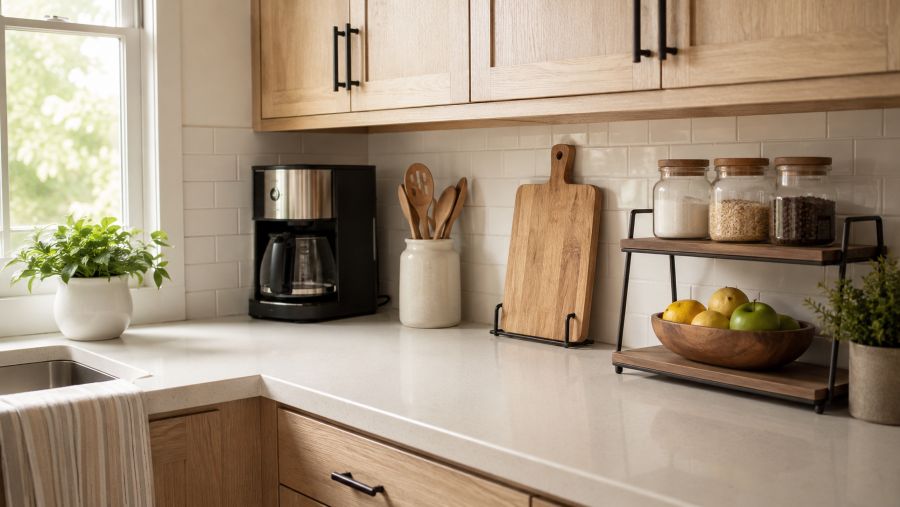
Countertop clutter is one of the most common complaints in any compact home, and it has an outsized effect on how a kitchen feels. A clear surface signals calm and invites you to cook, while a crowded one creates visual noise and slows down every task. Because small kitchens offer so little counter to begin with, every square centimeter you reclaim has a noticeably bigger payoff than it would in a large kitchen.
The encouraging news is that organizing a small countertop is mostly about decisions, not purchases. Before buying a single organizer, you’ll see how a clear-out and a simple zoning system do most of the heavy lifting. From there, we layer in vertical storage, corner tricks, and the specific products worth their footprint, finishing with the maintenance habits that keep everything in place.
Start by Decluttering Your Small Kitchen Countertop
Before any organizer can help, the counter needs a clean slate. The single most effective small kitchen countertop organization idea is also the cheapest: take everything off the surface and put back only what truly belongs there. Seeing the bare counter resets your perspective and reveals just how much usable space was hiding under the clutter all along.
As you decide what returns, apply the daily-use test. If you use an item every single day, such as a coffee maker or a favorite cutting board, it has earned its place. Anything used weekly or less belongs in a cabinet or drawer, where it stays accessible without stealing prime real estate. This one rule eliminates the slow creep of appliances and gadgets that quietly take over compact counters.
What to Remove From the Counter First
- Rarely used appliances such as a blender, stand mixer, or air fryer that only appear occasionally belong in a cabinet, not on display.
- Paper and mail piles create instant visual chaos; relocate them to a dedicated spot outside the kitchen entirely.
- Duplicate or broken tools waste space without adding value, so let go of the second can opener and the dull knife.
- Decor that doesn’t earn its footprint can be reduced to one or two meaningful pieces rather than a crowded collection.
- Cleaning bottles and sponges are better stored under the sink or in a small caddy than left scattered on the surface.
Work through the counter in one focused session rather than spreading it across days, since momentum keeps you decisive. Once the surface is genuinely clear, you’ll have an honest view of how much space you have to work with, and every organization idea that follows becomes far easier to apply effectively.
Create Zones to Keep Counters Functional
A clear counter is only useful if it stays that way, and the secret to lasting order is zoning. Professional organizers group related tasks and tools into dedicated areas, so everything you need for a job sits within arm’s reach. In a small kitchen, even modest zones dramatically reduce the back-and-forth shuffling that wastes both space and patience.
Simple Zones for a Compact Kitchen
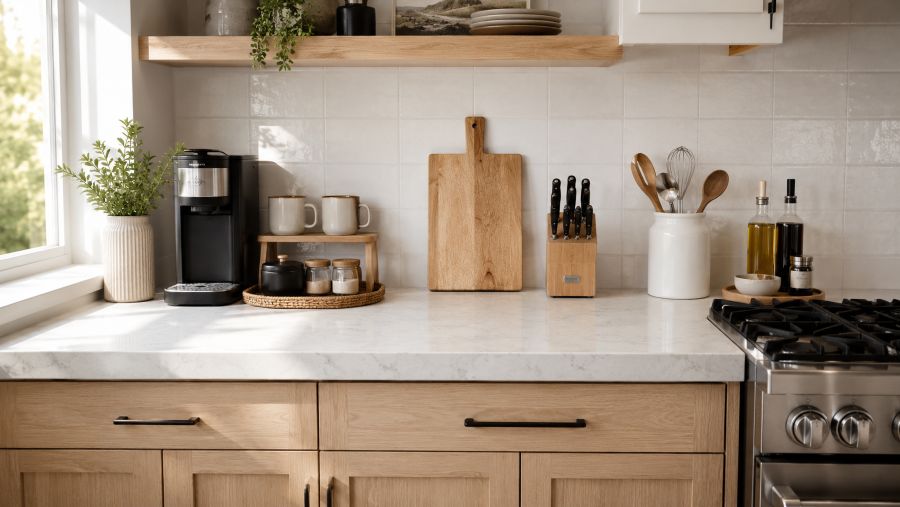
Begin with a coffee or beverage station, ideally in a corner, holding the machine, a small mug stack, and daily supplies on a compact tray that catches drips and keeps the group contained. Next, protect a clear prep zone near your main workspace, keeping it as empty as possible so you always have room to chop, mix, and assemble. Finally, set a cooking zone beside the stove with frequently used utensils in a crock and a small tray for oils and salt.
Using a tray or a small mat to define each zone is a subtle but powerful trick. The boundary signals where items belong and makes a stray mug or jar look obviously out of place, which nudges you to put it back. Because the zones live in the least useful parts of the counter, such as corners and the edges beside appliances, your central prep area stays open and ready for actual cooking.
Smart Small Space Tip: Always keep your largest stretch of counter completely empty as a dedicated prep zone. It’s tempting to fill every surface, but one clear workspace is worth more than three crowded ones. Treat that area as off-limits for storage, and your small kitchen will feel twice as functional.
Use Vertical Space to Free Up Your Countertop
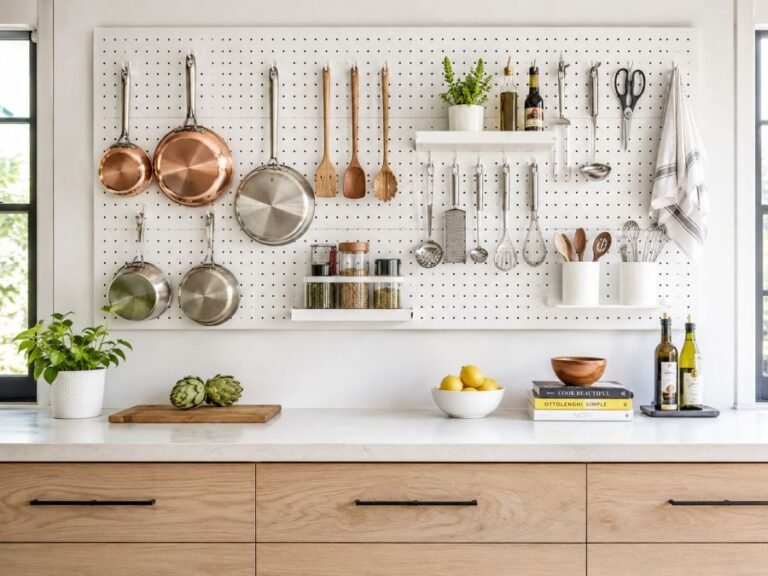
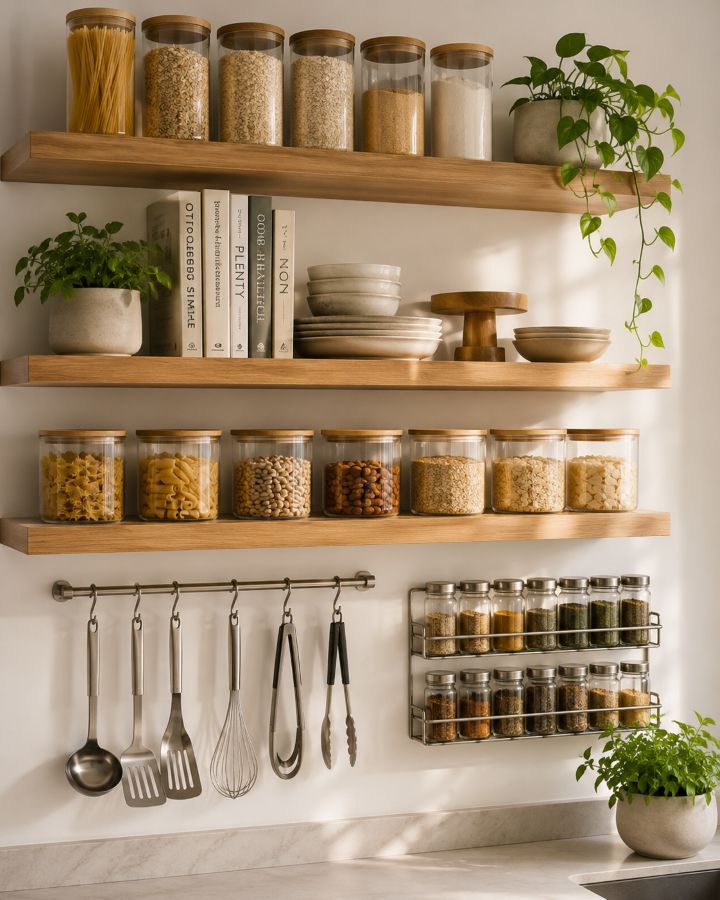
When the counter runs out of room, the answer is almost always to build upward. Vertical storage is the most valuable concept in small kitchen organization because it moves items off the precious horizontal surface and onto the walls and the undersides of cabinets, which usually sit completely unused. Best of all, most vertical solutions are renter-friendly and install without tools.
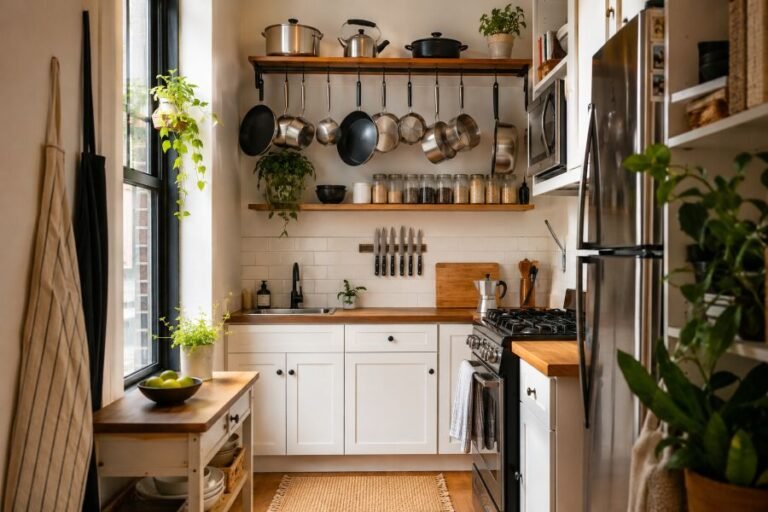
A magnetic strip mounted on the wall or the side of the fridge holds knives and metal tools in plain sight while clearing a drawer. A tension rod fitted under a cabinet or across a window can hang lightweight utensils and cloths from S-hooks. Riser shelves placed on the counter and inside cabinets double your storage by using the empty air above plates and jars. Each of these reclaims surface area without requiring a single new cabinet.
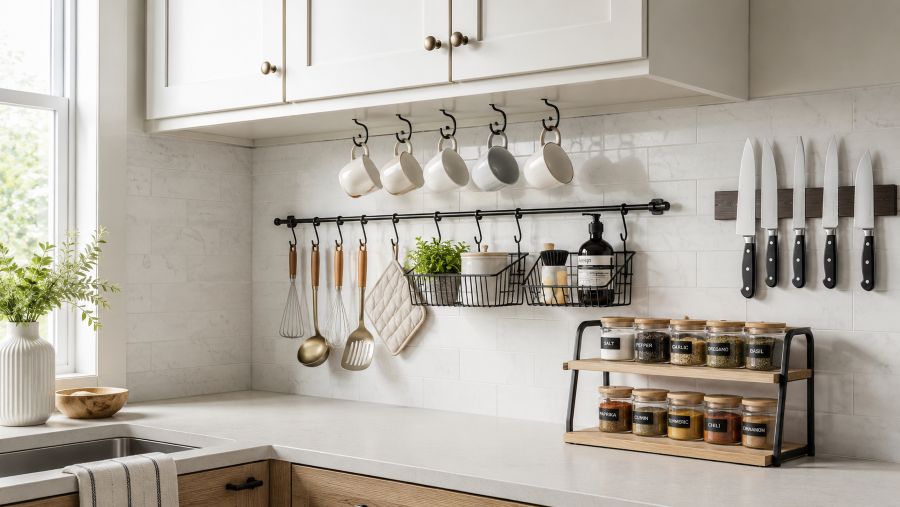
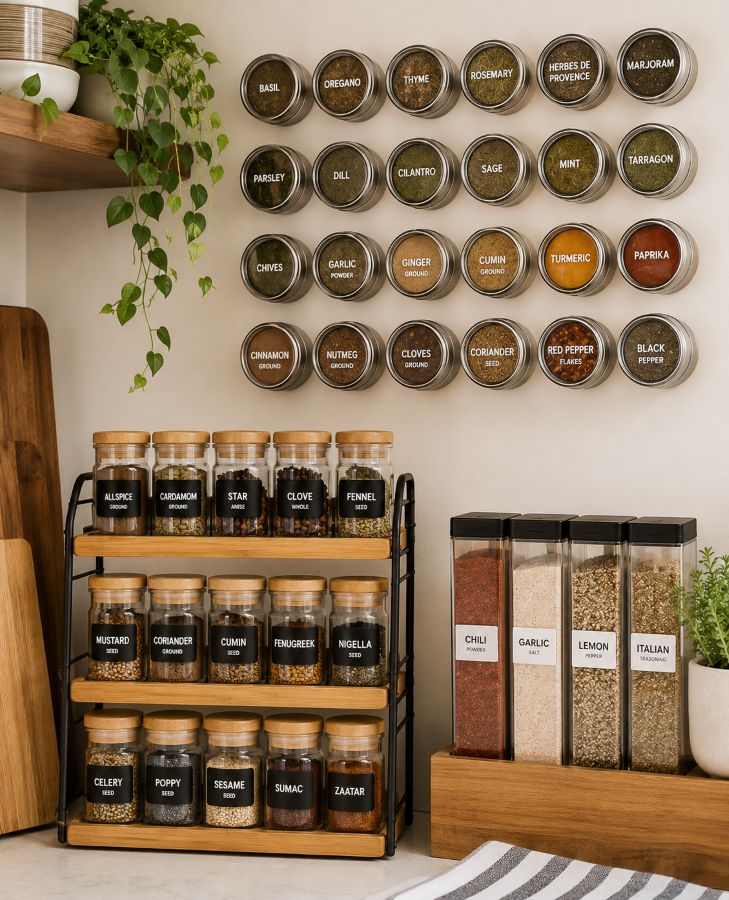
Hooks installed under the upper cabinets are another quiet win, turning dead space into a home for mugs, measuring cups, or small towels. Pair these with a slim wall-mounted rail and a magnetic spice rack, and you’ll be amazed how many items migrate off the counter. As a rule of thumb, ask of every countertop object whether it could live on a wall or under a cabinet instead, and act on the answer.
Smart Corner and Under-Cabinet Solutions
Corners and the awkward gap beneath upper cabinets are the most wasted areas in nearly every small kitchen. A corner organizer, whether a tiered stand or a simple lazy Susan, turns a hard-to-reach angle into accessible storage for oils, spices, or daily condiments. Spinning the tray brings the back items forward instantly, so nothing gets lost in the depths of the corner.
The space directly under the upper cabinets and above the counter is another opportunity. Slim under-cabinet shelves, mug hooks, and even small mounted baskets capture items that would otherwise spread across the surface. Meanwhile, the area over the sink, often dead space, can host a roll-up rack that doubles as a drying surface and a spot to stash produce or sponges. The table below summarizes the best targeted organizers and what each one solves.
| Problem Area | Best Organizer | What It Frees Up |
|---|---|---|
| Cluttered corner | Lazy Susan or tiered corner stand | Reclaims a dead angle for oils and spices |
| Spices spread across the counter | Shelf riser or magnetic spice rack | Returns a large patch of flat surface |
| Knives taking drawer or block space | Wall-mounted magnetic strip | Empties a drawer and a counter footprint |
| Wasted space over the sink | Roll-up over-the-sink rack | Adds a drying and prep zone instantly |
| Loose utensils on the surface | Under-cabinet rail with S-hooks | Lifts tools off the counter entirely |
Notice that each solution targets space the counter never truly needed, which is exactly why they work so well in compact kitchens. Rather than competing with your prep area, they expand storage into the neglected zones around it. Choose one or two that match your biggest pain points first, then add more only if the clutter genuinely calls for it.
Choosing the Right Countertop Organizers
Not every organizer deserves a place on a small counter, and adding the wrong ones can simply trade one kind of clutter for another. The goal is to choose pieces that consolidate several loose items into a single tidy footprint while still leaving your prep zone clear. Quality and proportion matter more than quantity here; one well-chosen organizer outperforms a counter crowded with cheap plastic trays.
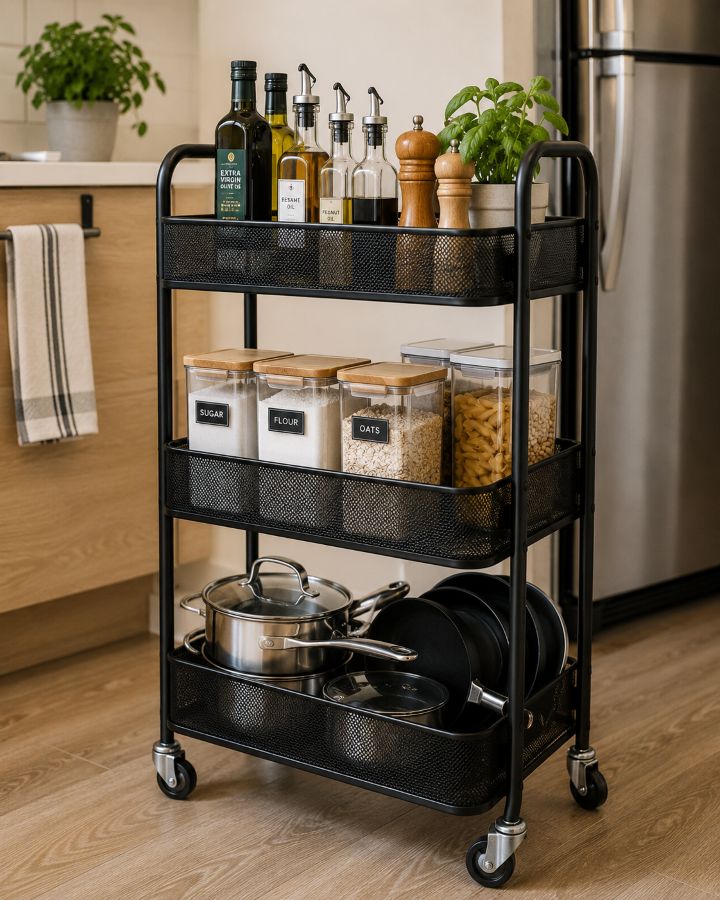
A slim utensil crock keeps your most-used tools upright and within reach without sprawling across the surface. A compact two-tier riser turns a small patch of counter into layered storage for jars or condiments. A narrow rolling cart, parked in a gap beside the fridge or under an overhang, adds a whole mobile storage unit that tucks away when you need the floor. Each of these earns its footprint by holding far more than its base would suggest.
When shopping, measure the available space first and favor organizers that match your kitchen’s materials and tones, since visual calm is part of feeling organized. Stick to a small, intentional set rather than buying every gadget that promises to save space. The most organized small kitchens often contain fewer organizers than you’d expect, because the real work was done by decluttering and zoning before a single product arrived.
Maintain a Clutter-Free Counter Every Day
Even the best system fails without simple upkeep, and a small kitchen counter can refill with clutter in just a few busy days. The most reliable way to stay organized is to build a quick reset into your routine rather than relying on occasional deep cleans. A few minutes of daily attention keeps the surface you worked so hard to clear from quietly disappearing again.
The most important habit is the nightly reset: before bed, return every stray item to its home, wipe the counter, and leave it ready for the morning. Pair this with a one-touch rule for incoming items, so mail, packaging, and bags are dealt with immediately instead of being dropped on the counter. Because every object now has a designated place, putting things away takes seconds rather than turning into a chore.
Finally, revisit the whole system every couple of months to catch new clutter and retire organizers that aren’t pulling their weight. Small kitchens reward this kind of light, regular maintenance far more than dramatic overhauls. With clear zones, smart vertical storage, and a steady daily habit, your countertop stays open, calm, and genuinely pleasant to cook on, no matter how compact the kitchen.
FAQ: Small Kitchen Countertop Organization
How do I organize a small kitchen countertop with limited space?
Start by clearing everything off, then return only the items you use daily. Group remaining essentials into zones, move rarely used appliances to cabinets, and use vertical risers, a slim utensil crock, and a corner organizer to free up flat surface. Keeping at least two-thirds of the counter clear instantly makes a small kitchen feel larger and easier to work in.
What should you keep on a small kitchen counter?
Keep only the things you reach for every single day, such as a coffee maker, a frequently used cutting board, a small utensil holder, and perhaps a fruit bowl. Everything used weekly or less should live in a cabinet or drawer. The daily-use rule is the fastest way to decide what earns a spot on a small countertop.
How can I add storage to a small kitchen without remodeling?
Use the vertical and unused areas instead of the counter. Add a tension rod or magnetic strip on the wall, stackable shelf risers inside cabinets, an over-the-sink rack, and hooks under the upper cabinets. These renter-friendly additions create new storage in minutes without tools, drilling, or a renovation.
How do I keep my kitchen counters clutter-free long term?
Give every item a permanent home, handle mail and packaging the moment it enters the kitchen, and do a quick reset each night so you start fresh. A small daily habit is far more effective than occasional deep cleans, and it keeps a small countertop from slowly filling up again.
Final Thoughts on Organizing a Small Kitchen Counter
Organizing a small kitchen countertop isn’t about owning more space; it’s about using the space you have with intention. By clearing the surface, creating purposeful zones, moving storage upward and into wasted corners, and choosing only the organizers that truly pull their weight, you transform a cramped, chaotic counter into a calm and capable workspace. The difference comes from a system, not a renovation.
Begin with the easiest, most rewarding step, a full declutter, and build from there at your own pace. Add one zone, one vertical solution, and one daily habit, and you’ll feel the kitchen open up almost immediately. Maintained with a few minutes of care each day, these small kitchen countertop organization ideas will keep your cooking space clear, efficient, and a genuine pleasure to use for years to come.
ADeL A.A
ADeL A.A is a home décor and space optimization writer who believes every square foot matters. He spends his time researching, testing, and comparing smart storage ideas, multi-functional furniture, and practical layout solutions — always searching for the best ways to make compact homes feel bigger, brighter, and better organized.
View all articles by ADeL A.A →